You’ve probably noticed how a weak battery can turn a leaf blower into a chore, but swapping in the right power source changes everything. Imagine a 20V, 4.0 Ah pack delivering steady torque while you clear dense debris, or a 56V, 2.5 Ah unit that keeps the motor humming through the toughest jobs. The right battery not only extends runtime but also protects the tool from overcharge and overheating, letting you work longer with less fatigue. Let’s explore the seven top choices that keep your blower performing like a pro.


More Details on Our Top Picks
Greenworks 40V 2.0Ah Lithium-Ion Battery
Compatible Tools)
The Greenworks 40V 2.0 Ah lithium‑ion battery is the ideal power source for anyone who needs a lightweight, fast‑charging pack that keeps a leaf blower running longer than any NiCd replacement. You’ll appreciate its 60‑minute quick charge, snap‑on/off design, and charge‑level indicator that lets you monitor power at a glance. This genuine Greenworks cell delivers consistent, fade‑free power and lasts three times longer than NiCd batteries, with no memory loss. It fits every G‑MAX 40V tool and charger model 29462, covering over 75 compatible devices. Plus, a two‑year warranty backs its reliability.
- Voltage:40 V
- Capacity (Ah):2.0 Ah
- Battery Type:Lithium‑Ion
- Quick‑Charge Time:60 min
- Warranty Length:2 years
- Compatibility Scope:G‑MAX 40 V tools only
- Additional Feature:Snap‑on/off design
- Additional Feature:Charge level indicator
- Additional Feature:3× longer run time
EGO POWER+ Battery 56V,2.5Ah – BA1400T
If you need a leaf blower that runs all day without overheating, the EGO POWER+ 56 V 2.5 Ah BA1400T battery is the perfect match. Its ARC Lithium design keeps temperature in check, while shock‑resistant housing protects against drops. Intelligent power management delivers consistent torque, and the Turbo Charger tops up 140 Wh in just 30 minutes. We 2.8 lb, it’s lightweight enough for extended use yet robust for any EGO outdoor tool. You also get a three‑year limited warranty on the battery and a year of commercial support, giving you confidence for every yard‑work session.
- Voltage:56 V
- Capacity (Ah):2.5 Ah
- Battery Type:Lithium‑Ion
- Quick‑Charge Time:30 min (Turbo Charger)
- Warranty Length:3 years (battery)
- Compatibility Scope:All EGO tools
- Additional Feature:ARC Lithium overheating protection
- Additional Feature:Turbo charger 30‑min charge
- Additional Feature:Intelligent power management
21V Cordless Leaf Blower with Dual Batteries and 2 Speeds
Homeowners who need a quick, lightweight solution for clearing leaves and debris will love the 21V cordless leaf blower with dual batteries and two speed settings. You’ll appreciate the 3.5‑lb ergonomic body that lets you work one‑handed without fatigue. The 2.0 Ah batteries charge in an hour and deliver up to 15 minutes on low or 10 minutes on high per charge; swapping the second pack doubles that runtime. Turbo tech pushes air to 150 MPH, handling patio dust and lawn leaves alike. Overheat protection, a five‑minute cooldown, and a year‑long storage window keep the unit safe. You also get 24‑hour after‑sales support and a 30‑day Amazon return guarantee.
- Voltage:21 V
- Capacity (Ah):2.0 Ah
- Battery Type:Lithium‑Ion
- Quick‑Charge Time:60 min
- Warranty Length:Not specified
- Compatibility Scope:21 V cordless leaf blower (includes 2 batteries)
- Additional Feature:Advanced Turbo technology
- Additional Feature:150 MPH max air speed
- Additional Feature:5‑minute cooldown period
20V 4.0Ah Lithium-Ion Battery Pack (2-Pack) for Black & Decker
Professional gardeners and landscaping pros will love the 20 V 4.0 Ah lithium‑ion pack because its high capacity delivers steady power for demanding tools like leaf blowers, hedge trimmers, and weed eaters. You’ll get two 20V 4.0 Ah batteries that keep a mower running longer between charges, and the pack’s stable output prevents torque drops during tough jobs. It fits every Black & Decker 20V Max tool you own—drills, sanders, vacuums, and more—so you can swap batteries without hunting for the right model. Built‑in over‑voltage, over‑current, over‑heat and over‑charge protection keeps you safe, and the 12‑month warranty backs up reliability.
- Voltage:20 V
- Capacity (Ah):4.0 Ah
- Battery Type:Lithium‑Ion
- Quick‑Charge Time:Not specified
- Warranty Length:12 months
- Compatibility Scope:Black & Decker 20 V Max tools
- Additional Feature:Over‑voltage & over‑current protection
- Additional Feature:CE, FCC, RoHS certified
- Additional Feature:Dual‑pack convenience
WORX 20V 4.0Ah WA3525 Battery Replacement
The WORX 20V 4.0Ah WA3525 battery replacement is ideal for anyone who needs extra runtime on a leaf blower without changing the tool’s form factor. You’ll get 4 000 mAh of capacity, delivering longer work periods than the stock pack, while the adaptive chip protects against overcharge, overcurrent, overvoltage, and overheating. Its 20 V lithium‑ion cells weigh just 300 g and fit the original dimensions, so you won’t notice any bulk. It’s compatible with the entire WORX 20 V Power Share line, including WA3575, WG151s, and WG540s. FCC, CE, and RoHS certifications back its safety, and a one‑year warranty guarantees peace of mind.
- Voltage:20 V
- Capacity (Ah):4.0 Ah
- Battery Type:Lithium‑Ion
- Quick‑Charge Time:Not specified
- Warranty Length:1 year
- Compatibility Scope:WORX 20 V Power Share tools
- Additional Feature:Adaptive protection chip
- Additional Feature:Same size as original
- Additional Feature:Reduced charging time
20V Leaf Blower 4.0Ah Battery Packs
If you need long runtime without frequent recharges, the 20V 4.0 Ah lithium‑ion pack in the PILENTO leaf blower delivers exactly that, giving you up to 30 minutes of continuous cutting on a single charge. You’ll appreciate the 610‑gram weight, which balances portability and power for a single‑battery setup. The pack’s lithium‑ion cells guarantee steady voltage and rapid recovery after brief pauses. As a best‑seller in Leaf Blower & Vacuum Parts, it ranks #2,123, reflecting solid performance. You also benefit from Amazon’s 30‑day return guarantee and a straightforward warranty, making it a reliable, hassle‑free choice for any 20V blower.
- Voltage:20 V
- Capacity (Ah):4.0 Ah
- Battery Type:Lithium‑Ion
- Quick‑Charge Time:Not specified
- Warranty Length:30‑day return guarantee
- Compatibility Scope:PILENTO 20 V leaf blower
- Additional Feature:Lightweight 610 g battery
- Additional Feature:Amazon 30‑day return guarantee
- Additional Feature:Best‑seller rank #671,627
Biswaye 20V Lithium Battery Compatible with Black & Decker
A 4 Ah 20 V lithium pack that’s fully compatible with Black & Decker’s 20 V MAX tools makes the Biswaye battery the ideal upgrade for anyone who wants longer run time on leaf blowers without worrying about memory‑effect degradation. You’ll appreciate its 4 Ah capacity, microchip‑controlled overcharge protection, and negligible self‑discharge, which keep the pack healthy for up to 500 cycles. It fits every Black & Decker 20 V MAX model—LBXR2520, LST522, LST300, and more—plus the LCS1620 charger. At 5.12 × 3.74 × 2.75 in and 436 g, it’s lightweight yet sturdy, and it meets FCC, RoHS, and CE standards for safety and reliability.
- Voltage:20 V
- Capacity (Ah):4.0 Ah
- Battery Type:Lithium‑Ion
- Quick‑Charge Time:Not specified
- Warranty Length:Not specified (Amazon return policy)
- Compatibility Scope:Black & Decker 20 V Max tools and chargers
- Additional Feature:Microchip prevents overcharge
- Additional Feature:Holds charge up to 500 cycles
- Additional Feature:FCC, RoHS, CE compliant
Factors to Consider When Choosing a Battery for Leaf Blower
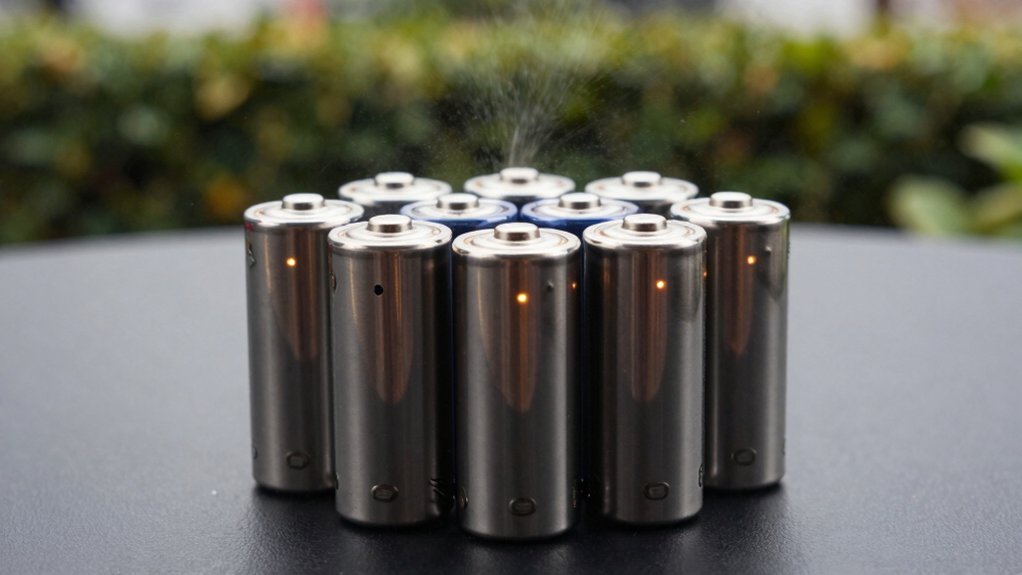
When picking a leaf‑blower battery, you’ll first compare voltage and capacity to match the tool’s power needs. Next, consider the chemistry type and how quickly it charges, which affects both efficiency and run time. Finally, weigh the battery’s weight and balance to guarantee comfortable handling during use.
Voltage Capacity and Voltage
Choosing the right battery for your leaf blower hinges on voltage and capacity, because voltage sets the power output while capacity (measured in amp‑hours) determines how long the tool runs. Higher voltage means stronger motor torque and the ability to tackle dense debris without stalling. In practice, a 36 V pack will feel noticeably more robust than a 20 V unit, especially on thick lawns. Capacity tells you how many minutes you’ll stay in the yard before recharging; a 4.0 Ah battery can outlast a 2.0 Ah counterpart by roughly double the time, assuming the same voltage. Always match both specs to the blower’s original rating—using a lower voltage can reduce performance, while a higher voltage may overload the motor. Likewise, swapping to a lower‑capacity cell will cut runtime, forcing frequent pauses. Aligning voltage and capacity guarantees consistent power and the expected work period.
Battery Chemistry Type
Reliability hinges on the battery chemistry you pick, because each type brings its own balance of energy density, weight, and lifespan. Lithium‑ion dominates leaf‑blower markets: it packs high energy per pound, discharges slowly, and avoids the memory effect that plagues older chemistries. If you need the cheapest option, lead‑acid looks tempting, but its bulk and low energy density quickly make it impractical for handheld use. Nickel‑cadmium suffers from memory loss, so you’ll see diminishing runtime unless you fully discharge each cycle. Nickel‑metal‑hydride offers a modest boost over cadmium, yet still retains that memory issue and lags behind lithium‑ion in density. Emerging lithium‑iron‑phosphate cells add safety and longer cycle life, giving you a robust alternative without sacrificing much power. Choose the chemistry that matches your weight tolerance, runtime expectations, and durability needs.
Charge Time Efficiency
The chemistry you pick determines how fast the battery can be recharged, and that directly impacts your workflow. If you need to keep the blower running all day, choose a cell that tops off in an hour or less. Lithium‑ion packs usually hit that mark, while older nickel‑cadmium units linger for several hours. Look for models that advertise “fast charge” or “turbo charge” – some hit 80 % in just 30 minutes, cutting downtime dramatically. Faster charging means you can swap batteries or plug in and get back to work without a long wait, which is essential when you’re on a tight schedule. Prioritize charge‑time efficiency to keep your tasks moving and avoid idle periods.
Run Time Duration
A higher‑capacity battery—say, 4 Ah or more—will keep your leaf blower running noticeably longer than a lower‑capacity pack, but the actual runtime also hinges on the blower’s speed setting, the thickness of the debris, and ambient temperature. When you crank the speed to max, the motor draws more current, draining even a 4 Ah pack in minutes. Light, dry leaves let you stretch the charge, while wet or dense clippings demand more power, shortening the session. Cold weather increases internal resistance, reducing available capacity. Manufacturers usually list a benchmark runtime under ideal conditions; use that as a baseline and adjust for your typical workload. Store the battery upright, avoid full discharges, and keep it at moderate temperature to preserve its usable Ah over time.
Weight and Balance
Two‑kilogram batteries can make a big difference in how a leaf blower feels in your hands. A lightweight pack keeps the tool balanced, letting you swing it with less effort and reducing fatigue on long days. When the battery sits near the blower’s center of gravity, the weight distribution stays even, so you maintain steady control even around obstacles. If you choose a heavier cell, it can shift the balance forward or backward, making the unit feel clunky and harder to steer. Pay attention to where the battery aligns with the air intake and motor; proper placement offsets bulk and preserves maneuverability. Ultimately, consider the total weight of the blower plus battery to guarantee the package feels comfortable and easy to manipulate.
Safety Protection Features
Balancing a leaf blower is only half the story; you also need to make certain the battery won’t become a safety liability. When you pick a battery, look for built‑in overcharge, overcurrent, and overheating protection; these safeguards stop damage before it escalates into a fire or explosion. Verify the unit complies with FCC, RoHS, and CE standards so you know it meets industry safety benchmarks. Adaptive chip technology is a game‑changer—its real‑time monitoring adjusts power flow, keeping temperature and current within safe limits. Choose a shock‑resistant, rugged case to survive drops or impacts on the job site. Finally, follow proper storage and maintenance guidelines: keep it cool, charge it regularly, and inspect connectors for wear. These steps guarantee reliable, safe performance every time you fire up the blower.
Compatibility With Tools
Three key factors determine whether a battery will work seamlessly with your leaf blower: voltage match, physical fit, and connection type. First, check the voltage rating; a 20 V battery on a 12 V blower can overload the motor, while a lower voltage won’t deliver enough power. Next, measure the battery’s dimensions and mounting brackets; it must slot into the tool’s compartment without forcing or blocking the trigger. Finally, verify the connector—most modern blowers use a proprietary plug, but some accept standard 5‑pin or barrel connectors. If the plug doesn’t align, you’ll need an adapter, which can add resistance and heat. Matching these specs guarantees reliable performance, prevents premature wear, and lets you swap batteries across compatible models without hassle.
Warranty and Support
A solid warranty and responsive support team are essential when you pick a leaf‑blower battery, because they protect you from defects and give you peace of mind. Aim for at least a one‑to‑two‑year warranty; that window covers most manufacturing flaws and lets you claim a replacement without hassle. Make sure the brand’s customer service is reachable by phone, email, or chat, and that they have a reputation for quick, helpful responses. Verify the battery’s compatibility with your specific blower model to avoid mismatched connections or performance loss. Look for built‑in safety features such as over‑charge, over‑current, and over‑temperature protection, which reduce failure risk. Finally, choose a reputable manufacturer known for durable, consistent performance, as their track record often predicts reliable warranty honor.