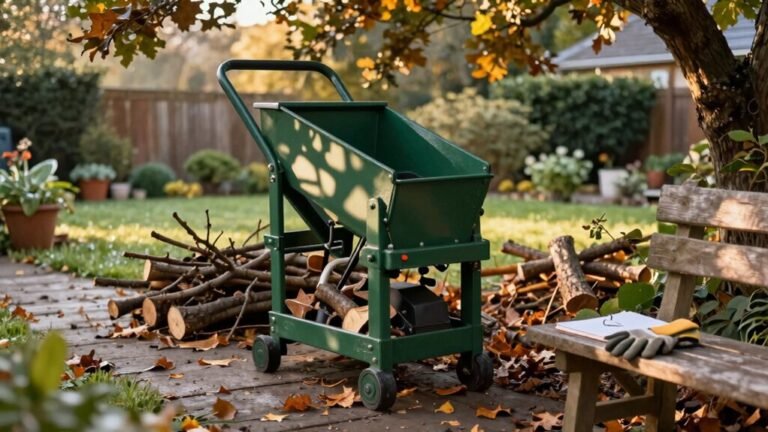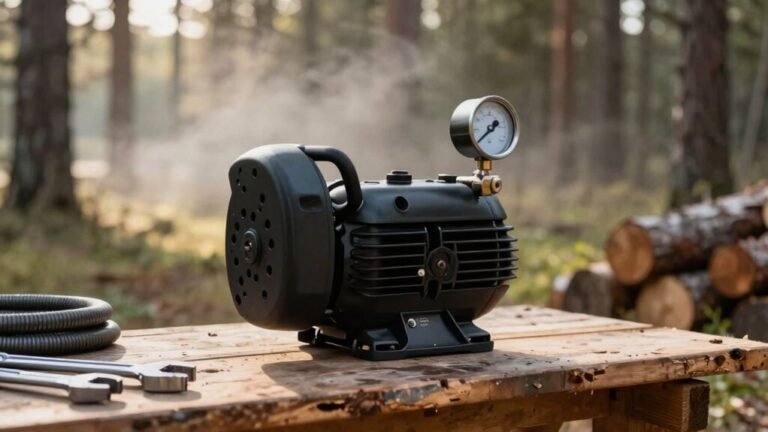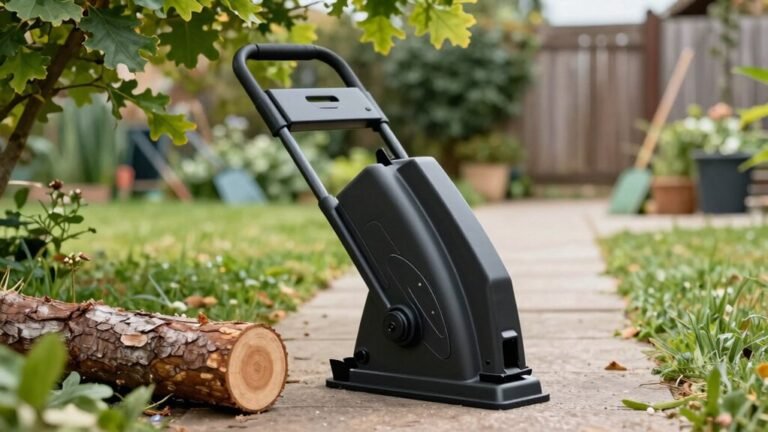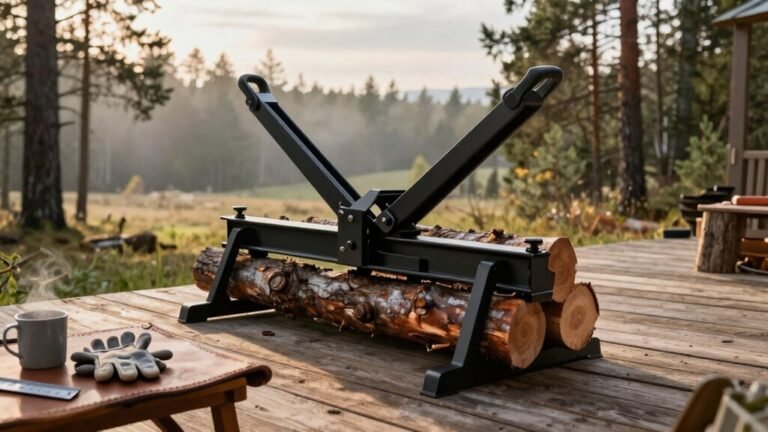
Match your splitter to three things: log size, wood type, and how often you’ll use it. Vertical splitters handle logs over 14 inches faster and easier on your back, while horizontal ones deliver premium splits for regular burning. You’ll need 10–12 tons for softwoods, but 15–20 tons for stubborn hardwoods—green oak demands even more force. Budget models under $2,000 work great for homeowners. Understanding cycle time and maintenance keeps your machine running strong for years.
Which Log Splitter Type Fits Your Needs: Horizontal vs. Vertical
When you’re standing in front of a pile of logs wondering which splitter will actually work for your situation, the choice between horizontal and vertical machines is probably the biggest decision you’ll make—and it’s worth getting right because each type handles wood differently and puts your body through different levels of punishment.
Horizontal splitters work best for smaller logs in domestic settings. You’ll lift them onto the machine, but the actual splitting feels more comfortable overall. Vertical splitters eliminate that lifting entirely by letting you roll large rounds into adjustable arms, which dramatically reduces ergonomic strain on your back. For wood larger than 14 inches, vertical splitters become faster due to their continuous upward feeding design that reduces jamming. The good news is dual-position models give you flexibility for varied wood types. Consider your wood volume and physical capabilities—vertical machines handle hard or green wood better, while horizontal delivers premium splits for regular household burning. Vertical splitters excel when you need to process high‑volume, thick logs efficiently. Always wear protective gear before operating a log splitter to prevent injuries. Choosing the right power source can also impact performance and portability.

27-Ton Splitting Force for Demanding Jobs: Driven by a robust 7 HP 209cc OHV engine, this gas-powered splitter delivers a full 25 tons of force with 9.14 ft.-lb. of torque. This massive power ensures it can handle logs efficiently, saving you significant time and effort.

30-Ton Capacity of Splitting - Powered by a robust 7.5 HP 223 cc single-cylinder OHV engine, this hydraulic log splitter generates an impressive 30 tons of splitting force to process hardwood logs rapidly and with minimal effort, ensuring quick completion of demanding splitting tasks.

Powerful Performance - Equipped with a 7HP AlphaWorks engine and 2-Stage Bucher Hydraulic Gear Pump, our log splitter effortlessly handles logs up to 20" long and 24" in diameter.
Pick Your Power Source: Gas, Electric, or Tractor-Powered
Once you’ve settled on whether a horizontal or vertical splitter makes sense for your setup, the next fork in the road is figuring out what actually powers the thing—and honestly, this decision shapes your entire experience with the machine.
Gas-powered splitters deliver raw power for serious, frequent work on larger logs. You’ll get portability without outlet dependency, though you’re trading fuel efficiency and maintenance headaches for that muscle. Electric models suit occasional users tackling smaller jobs near power sources. They’re quieter, lower-maintenance, and neighbor-friendly. The trade-off? Limited power and range. Tractor-powered hydraulic splitters work brilliantly if you’ve already got equipment on hand—your power source becomes built-in, though fuel costs might offset savings. Match your power source to your actual workload, not what you think you’ll need. Electric splitters typically provide 5-6 ton splitting capacity, making them well-suited for logs up to 10 inches in diameter. Reduced emissions also make electric units an environmentally responsible choice for frequent firewood processing. Always inspect safety gear before each session to prevent injuries. Consider the noise level of each type to ensure compliance with local ordinances and neighbor comfort.

Powerful, 6.5 Ton RAM Force to get the job done fast

POWERFUL: The 12 ton hydraulic log splitter can split logs up to 17.7 in long and 7.9 in diameter (Depending on wood density)

【POWERFUL MOTOR FOR EFFORTLESS CUTTING】 The PowerSmart electric hydraulic log splitter boasts a 15 Amp induction motor with 3450 rpm, ensuring stable performance. The 6.5-ton hydraulic system easily splits larger logs into firewood. Durable steel construction ensures reliable use for years to come.
Match Splitting Force to Your Log Size and Wood Type
All that talk about power sources matters less than one critical reality: if your splitter can’t actually handle the logs you’re throwing at it, you’ve bought the wrong machine. Here’s the thing: matching splitting force to your wood selection and log moisture content isn’t complicated, but it matters tremendously.
Softwoods like pine need 10-12 tons, while hardwoods like oak demand 15-20 tons. Green wood—that freshly cut, moisture-laden stuff—requires considerably more force than seasoned wood. A 2-foot oak log, if green, needs 30-35 tons; seasoned, it’ll split with 25-28 tons.
Log diameter matters too. Twelve-inch logs suit 20-ton splitters comfortably. Push to 12-18 inches with hardwoods, and you’ll want 25 tons minimum. Base your purchase on the largest, toughest logs you’ll actually encounter.
Understanding log moisture content is essential for selecting the appropriate splitter capacity. Properly bleeding a hydraulic cylinder ensures the system operates efficiently and safely. Kinetic splitters offer rapid cutting speed but may struggle with large-diameter or frozen logs.

SPECS - Built with a heavy-duty 7HP gas engine, powering our 20-ton rated system, utilizes the highly ultra reliable and trusted 2-Stage Bucher Hydraulic Gear Pump. With Rapid Auto Return that easily splits logs up to 20" inches in length and up to 16" inches in diameter; All weighing 130lbs

Compatible Fitment References: Fits Huskee 20T LS401211/21-53053 & 22T 401622TSK/1032822; CountyLine 22T 401622CL/1032822; SpeeCo/SplitMaster 22T 40123300/401233CA/401622PH/401622BL; Oregon 22T S402022H0/S402022K0; Dirty Hand Tools 22T 100171; S39017800 reference

SPECS – Powered by an AlphaWorks 7HP 4 stroke OHV gas engine paired with the ultra-reliable and trusted 2-Stage Bucher Hydraulic Gear Pump. Easily splits logs up to 20" inches in length and up to 16" inches in diameter; In a platform weighing in at 130lbs.
Cycle Time: How Much Wood Can You Process Per Hour?
How fast your splitter actually works matters just as much as how hard it hits—and here’s why: you could own the most powerful machine on the market, but if it takes forever to cycle back and forth, you’ll spend all day splitting what should’ve taken a couple hours.
Cycle efficiency directly impacts your log throughput. Most splitters complete a cycle in 10 to 20 seconds, though faster hydraulic models reach 8 seconds. That difference matters enormously—an 8-second splitter processes a full cord in roughly an hour, while a slower 20-second machine takes considerably longer. Adding a flow restrictor can fine‑tune your cycle speed without compromising the hydraulic performance of other machine functions.
What most people don’t realize is that the return stroke often eats up most of your time. Choose a machine with quick retraction, and you’ll blast through your woodpile faster than you’d expect. Properly inspect seals during maintenance prevents premature wear and ensures consistent cycle timing. Understanding the fuel‑mix ratio is essential for reliable operation. Regularly check pump pressure to confirm the system is delivering the required force.
Best Budget Log Splitters for Homeowners Under $2,000
Now that you’ve got a solid understanding of cycle time and how it affects your actual productivity, it’s time to talk money—because the splitter that gets the job done doesn’t have to drain your wallet. You’ll find quality gas-powered models in the $1,500-$2,000 range that deliver serious performance. The CountyLine 28-Ton with its Kohler 6.5 HP engine sits at $1,599 and handles horizontal/vertical operation beautifully. NorthStar consistently outperforms competitors at this price point, while the HyperSplit 32-Ton tackles brutal hardwoods like locust. Here’s the thing: you’re getting excellent ROI on these budget picks. Check Tractor Supply or Home Depot for sales offering 15-30% off MSRP. A 32-ton splitter recommended over 25-ton models provides faster stage-one operation and higher tonnage capacity for only a few hundred dollars more. Compare warranties carefully—they’ll protect your investment and reveal manufacturer confidence in durability. Properly securing the hydraulic cylinder with reinforced brackets ensures safety and longevity. Using a bench grinder at the proper angle helps maintain blade sharpness for optimal performance. Battery-powered tools can also offer comparable power with lower emissions, expanding eco‑friendly options for woodworkers.

Powerful 40-Ton Splitting Force - Driven by a massive 389cc, 13 HP single-cylinder OHV engine producing 16.96 ft.-lb. of torque, this hydraulic splitter delivers a crushing 40 tons of force. Effortlessly power through the toughest hardwoods and tackle demanding jobs with speed and ease.

Reliable 223cc FULL BOAR OHV engine delivers 33-ton force and cycles in just 14.3 seconds for a fast and easy splitting
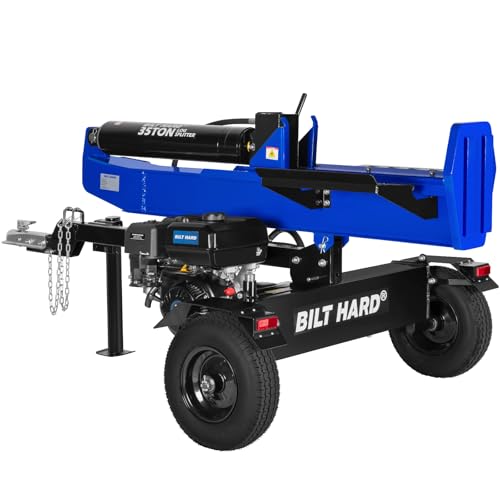
Powerful 35-Ton Splitting Capablity- Powered by a robust 10 HP 301 cc single-cylinder OHV engine, this hydraulic log splitter generates an impressive 35 tons of splitting force. It processes hardwood logs rapidly and with minimal effort, ensuring quick completion of demanding splitting tasks.
Log Lift Systems and Two-Way Splitting: Features That Make Work Easier
Once you’ve settled on a solid mid-range splitter, you’ll start noticing something pretty quick—manually positioning and wrestling those monster logs gets old *fast*. That’s where hydraulic log lifts save your back and sanity.
You’ll find lifts integrated into models like the RuggedMade 300 and 700 series, which position logs precisely for two-way splitting efficiency. The hydraulic mechanism handles the heavy lifting while you control positioning, whether you’re splitting horizontally or vertically. These lifts keep split pieces on the platform, eliminating the need for ground cleanup after each session.
Hydraulic systems rely on pressure flow to provide consistent lifting power. Understanding fluid dynamics helps you grasp why pressure stability is crucial for smooth operation.
Here’s the thing—safety matters too. Quality systems include cage safety barriers keeping you clear of suspended logs, plus camera integration with LCD monitors giving you full visibility in tight spaces. That rearview perspective eliminates blind spots, letting you work confidently. Combined with rotator-equipped grapples, modern lifts streamline your entire workflow, turning backbreaking yard work into something genuinely manageable.
When bleeding a hydraulic cylinder without a dedicated bleeder valve, you can safely purge air by attaching a clear hose to a high point and cycling the cylinder, a technique that ensures air removal before re‑pressurizing.

BOX-shape Beam: Experience unparalleled strength and durability with our BOX beam Design Log Splitter. Engineered to outperform traditional I beam designs, our splitter ensures superior stability and power, providing you with the confidence to tackle even the toughest logs. Elevate your wood splitting game with the unmatched strength of our BOX beam design.

1) Excellent Performance: This hydraulic wood splitting machine pump has a maximum working pressure of 3000 PSI, maximum speed of 3600 RPM, inlet port is 1 inch and outlet port is 1/2 inch NPT, which can efficiently achieve wood cutting and improve work efficiency
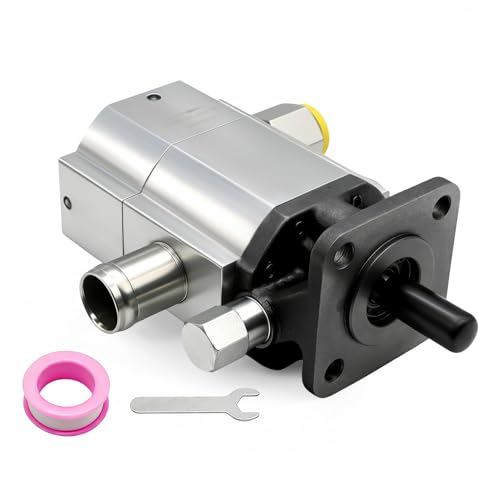
1) Excellent Performance: This hydraulic wood splitting machine pump has a maximum working pressure of 3000 PSI, maximum speed of 3600 RPM, inlet port is 1 inch and outlet port is 1/2 inch NPT, which can efficiently achieve wood cutting and improve work efficiency
Safety and Portability: Move Your Splitter Between Job Sites
All that convenience from your hydraulic lift system doesn’t mean much if you can’t get your splitter to the next job site without creating a safety nightmare. Here’s the thing: a compact safety design matters just as much as raw power. Before you move your splitter anywhere, lock those wheels down—seriously, this prevents dangerous rolling. Always place it on level, stable ground to avoid tipping disasters. Turn off and disengage the power completely before relocating. Look for models with portable design features like safety shields and automatic ram returns; they’re game-changers for transport. Store your splitter in a dry, covered space away from kids and pets. Smart portability protects both your equipment and everyone around it. Hydraulic cylinder seals are essential for maintaining pressure and preventing leaks during frequent moves. Check hydraulic fluid regularly to ensure the system operates safely and efficiently.
Know When to Stop Splitting by Hand and Buy a Machine
Your back’s probably telling you something if you’ve been swinging an axe or maul for more than a season or two. Hand splitting fatigue is real, and it compounds every year you delay switching to a machine. Here’s the thing: your annual wood needs determine payback timing more than anything else. If you’re processing cords yearly, you’ll recoup a machine investment within 2-3 seasons. For occasional users, hand tools remain practical. But when splitting becomes drudgery rather than enjoyment, a hydraulic splitter—even a basic $1,000 model—transforms the job. Over 11 years, hand splitting adds roughly 33 extra days of labor compared to machine splitting. Your knees, shoulders, and lower back will thank you. That’s not laziness; that’s smart equipment planning.